


Choosing the right digital marketing channels for a Massachusetts business is not about picking whatever platform is trending. It is about matching your budget, your customers, and your local market to the channels that actually move sales.
Massachusetts is a competitive place to market a business. Boston, Worcester, Springfield, and Cambridge each have their own customer habits, and industries like healthcare, higher education, technology, and tourism all compete for the same online attention. This guide breaks down a simple, repeatable process for choosing the channels that fit your goals, your customers, and your budget.
Quick answer
Start with your customer's search behavior, your available budget, and your sales cycle. Local service businesses usually see the fastest return from Google Business Profile and local SEO. Product based businesses often benefit from paid search and social ads. Businesses with a longer sales cycle, such as B2B firms in the Route 128 tech corridor, tend to do well with content marketing, LinkedIn, and email nurturing.
Why Channel Selection Matters More in Massachusetts
Massachusetts has one of the highest concentrations of small businesses per capita in New England, and many of them are competing in the same digital spaces. A landscaping company in Worcester and a dental practice in Newton face very different search competition, yet both are often tempted to copy the same generic marketing playbook.
Picking channels without a plan usually leads to wasted ad spend, inconsistent branding, and content that never reaches the right audience. A structured approach protects your budget and gives you a clearer picture of what is actually working.

Step 1: Start With Your Customer, Not the Platform
Before comparing channels, define who you are actually trying to reach. A few questions help clarify this quickly.
- Are your customers searching with buying intent, such as "emergency plumber Worcester," or are they browsing casually on social platforms?
- Is your service local and neighborhood based, or does it serve all of New England or the entire country?
- How long does a typical customer take to decide, a same day decision or a multi month evaluation?
- What age group and income level makes up most of your customer base?
A local locksmith in Lowell has a very different answer to these questions than a SaaS company headquartered near Kendall Square, and the channel mix should reflect that difference.
Step 2: Understand the Massachusetts Digital Landscape
Massachusetts residents are highly connected. The state has one of the highest broadband adoption rates in the country and a dense, well educated population concentrated around Greater Boston. That means search competition is high, but it also means digital channels can be very efficient when targeted correctly.
Seasonality also plays a role. Many Massachusetts businesses, from landscaping to home services to tourism, see demand shift sharply with the seasons. Channel strategy should flex around these cycles rather than staying static all year.
Step 3: Compare the Core Digital Marketing Channels
Most Massachusetts businesses choose from a similar set of channels. The right combination depends on your goals, timeline, and budget.
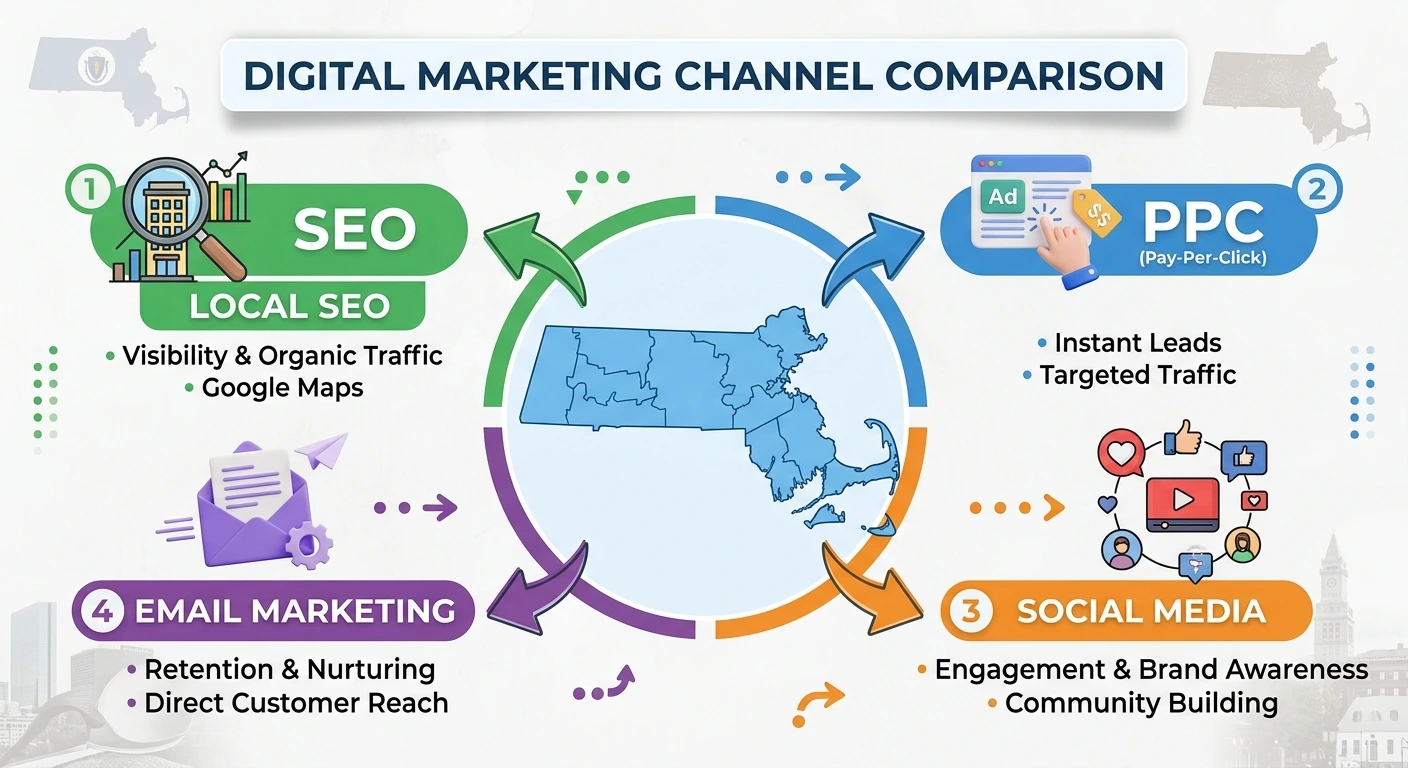
Search Engine Optimization (SEO)
SEO builds long term visibility in organic Google results. For a Massachusetts business, this often means ranking for terms like "roofing contractor Braintree" or "family dentist Cambridge." It takes months to build momentum, but the traffic tends to be steady and does not disappear the moment you stop paying for it.
Local SEO and Google Business Profile
For any business with a physical location or a defined service area, an optimized Google Business Profile is often the single highest return channel available. It controls how you show up in Google Maps results and the local pack, which is where most nearby customers look first.
Pay Per Click Advertising (PPC)
Google Ads and Microsoft Ads put you at the top of search results immediately. This is useful for businesses that need leads quickly, or that operate in a niche where organic ranking will take too long to matter. The tradeoff is that traffic stops the moment the budget stops.
Social Media Marketing
Platforms like Instagram, Facebook, and TikTok are strong for businesses with a visual product, a younger audience, or a community focused brand. Restaurants, retail shops, and event based businesses across Boston often see strong engagement here, while B2B companies tend to get better results from LinkedIn.
Email Marketing
Email remains one of the most cost effective channels available. It works especially well for businesses with repeat customers, seasonal promotions, or a longer sales cycle that benefits from ongoing nurturing.
Content Marketing
Blog posts, guides, and videos build authority over time and support SEO and social channels at the same time. This channel is especially useful for businesses that need to educate customers before they buy, such as financial services or healthcare providers.
Channel Comparison Table
| Channel | Time to Results | Typical Cost | Best For |
|---|---|---|---|
| Local SEO / Google Business Profile | 4 to 8 weeks | Low | Local service businesses |
| Organic SEO | 3 to 6 months | Moderate | Long term growth |
| PPC Advertising | Immediate | Moderate to high | Fast lead generation |
| Social Media | 2 to 6 weeks | Low to moderate | Brand awareness, community |
| Email Marketing | Immediate to ongoing | Low | Repeat customers, retention |
| Content Marketing | 2 to 4 months | Low to moderate | Education, authority building |
Step 4: Match Channels to Your Budget
Budget often decides more of the channel mix than businesses expect. A useful rule for a growing Massachusetts business is to split spending across three categories rather than putting everything into one channel.
- Foundation channels: Google Business Profile and basic local SEO. These should almost always be funded first, since they are low cost and drive local visibility.
- Growth channels: PPC or social ads, used to generate leads while the foundation channels build momentum.
- Compounding channels: content marketing and email, which take longer to pay off but keep working with little added cost once built.
Businesses with a limited monthly budget, often under a few thousand dollars, usually get the best return by prioritizing local SEO and email before adding paid advertising.
Step 5: Consider Your Industry
Massachusetts has a diverse economy, and the right channel mix often follows the industry.
- Healthcare and legal practices tend to rely on local SEO, Google Business Profile, and content marketing that builds trust before a first appointment.
- Technology and B2B companies near the Route 128 corridor often see stronger results from LinkedIn, content marketing, and email nurturing over a longer sales cycle.
- Retail, restaurants, and hospitality businesses in Boston and Cambridge typically benefit most from social media and local search combined.
- Home services and contractors across the state usually see the fastest wins from Google Business Profile, local SEO, and targeted PPC campaigns.
Common Mistakes Massachusetts Businesses Make
A few patterns show up again and again when businesses choose channels without a plan.
- Running paid ads without an optimized Google Business Profile, which wastes clicks that could have converted for free.
- Choosing a channel because a competitor uses it, without checking whether their own customers actually behave the same way.
- Spreading a small budget across too many channels at once, instead of fully funding one or two channels first.
- Ignoring seasonal demand shifts that are common across New England industries.
Why You Can Trust This Guide
This framework is built from patterns seen across dozens of Massachusetts small businesses, from Boston based service companies to regional retailers. Recommendations here reflect what actually drives measurable leads and revenue, not general theory. Every business is different, so treat this as a starting framework rather than a rigid rule.
A Simple Framework for Choosing Your Channels
When narrowing down your options, run through these four questions in order.
- Where does my ideal customer actually search or scroll first?
- How quickly do I need results, and what can my budget sustain?
- Which channel can I maintain consistently with the team and time I have?
- Which one or two channels, if fully funded, would move the needle most this quarter?
Most Massachusetts businesses do better mastering two channels fully than spreading thin across five.
Frequently Asked Questions
What is the best digital marketing channel for a small Massachusetts business?
For most small, locally focused businesses, Google Business Profile combined with local SEO delivers the fastest and most reliable return, since it targets customers who are already searching nearby.
How much should a small business in Massachusetts spend on digital marketing?
A common starting range is 7 to 12 percent of gross revenue, though many small businesses begin with a modest monthly budget focused on local SEO and one paid channel, then scale as results come in.
Should I use SEO or PPC first?
If you need leads quickly, start with PPC. If you can wait a few months and want lower long term cost per lead, build SEO first, or run both together if budget allows.
Is social media worth it for a service based business in Massachusetts?
It depends on the service. Visual or community driven services, such as home renovation or event planning, tend to perform well. Highly technical B2B services often get more value from LinkedIn and content marketing instead.
How many digital marketing channels should a small business use at once?
Two to three well managed channels almost always outperform five channels run without enough time or budget behind each one.
Does location within Massachusetts affect channel choice?
Yes. Businesses in dense areas like Boston and Cambridge face heavier search competition, which can make local SEO and Google Business Profile even more valuable, while businesses in less competitive regions may find quicker wins with paid search.
Final Verdict
There is no single best channel for every Massachusetts business. The right approach starts with your customer's behavior, follows your budget, and adjusts for your specific industry and location within the state. Begin with a strong local foundation, add one growth channel that fits your sales cycle, and build compounding assets like content and email along the way.
Expert Tip
Before adding a new channel, fully claim and optimize your Google Business Profile first. It is free, it is often the highest converting asset a local Massachusetts business has, and it makes every other channel work better once it is set up correctly.
Freelance writer and digital marketing expert with 15 years of experience in web development, web design, SEO, and digital marketing. I have successfully managed numerous digital marketing campaigns and developed large-scale websites for businesses.